
So you probably have heard that I got job at Xerox. I think that Xerox is Rich with history and it’s pretty amazing what’s transgressed over the years. The technology itself is amazing and life would not be the same without it.
Where should I start? Xerox has been around forever! It was founded in 1906 in Rochester, New York, as “The Haloid Photographic Company.” It manufactured photographic paper and equipment. Then in 1938 something amazing happened. A physicist by the name of Chester Carlson was working in a patent office. Everything was copied by hand and he found this was awfully time consuming. He knew there had to be an easier way. It would take nearly 20 years of refinement but, in the end xerography was born. Let me walk you through it.
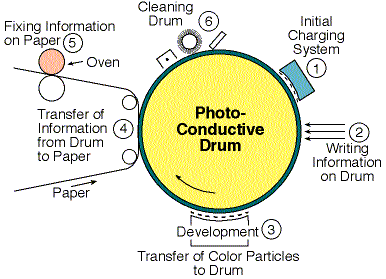
- Charging – A cylindrical drum is electrostatically charged by a high voltage wire called a corona wire or a charge roller. The drum has a coating of a photoconductive material. A photoconductor is a semiconductor that becomes conductive when exposed to light.
- Exposure – A bright lamp illuminates the original document, and the white areas of the original document reflect the light onto the surface of the photoconductive drum. The area of the drum that are exposed to light become conductive and therefore discharge to the ground. The area of the drum not exposed to light (those areas that correspond to black portions of the original document) remains negatively charged.
- Developing – The toner is positively charged. When it is applied to the drum to develop the image, it is attracted and sticks to the area that are negatively charged (black areas), just as a paper sticks to a balloon with a static charge.
- Transfer – The resulting toner image on the surface of the drum is transferred from the drum onto a piece of paper that has an even greater negative charge than the drum has.
- Fusing – The toner is melted and bonded to the paper by heat and pressure rollers.
Just a note – A negative photocopy inverts the colors of the document when creating a photocopy, resulting in letters that appear white on a black background instead of black on a white background. Negative photocopies of old or faded documents sometimes produce documents that have better focus and are easier to read and study.
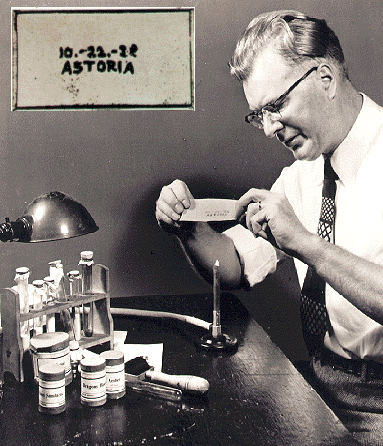
Now that you get a sense of the science lets get caught up with the rest of history. Joseph C. Wilson, was credited as the “founder of Xerox,” after he took over Haloid from his father. In 1946 Wilson and Carlson signed an agreement to develop it commercially. Haloid was the ones who coined the term “xerography,” which is Greek for “dry writing.” Haloid changed its name to Xerox in 1958 and then to Xerox Corporation in 1961. Wilson remained President/CEO of Xerox until 1967 and served as chairman until his death in 1971.
Xerox tested the market by introducing a hand-operated prototype known as the Flat-plate 1385. It was too slow to be sold as a viable copier so, in consequence, it was sold as a platemaker for the Addressograph-Multigraph Multilith 1250 and related sheet-fed offset printing presses in the offset lithography market. A skilled user could produce fast, paper and metal printing plates of higher quality than almost any other method. In 1955 immediately following the 1385 came the first automatic xerographic printer, the Copyflo.
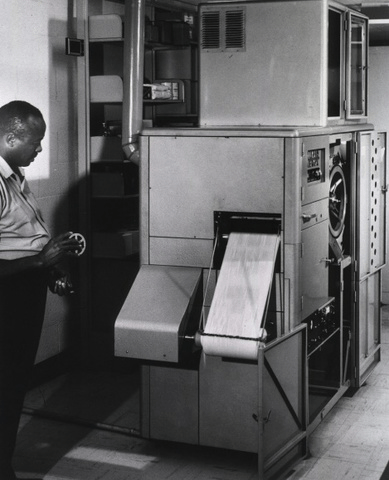
The Copyflo was a large microfilm printer that could produce positive prints on roll paper from any type of microfilm negative. The process was then scaled down to produce the 1824 Microfilm Printer.
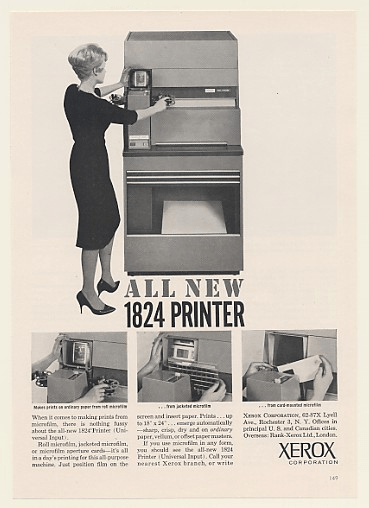
At about half the size and weight, this still sizeable machine printed onto hand-fed, cut-sheet paper, which was pulled through the process by one of two gripper bars. Once again they scaled it down and this was to become the basis for the 813 Desktop Copier.

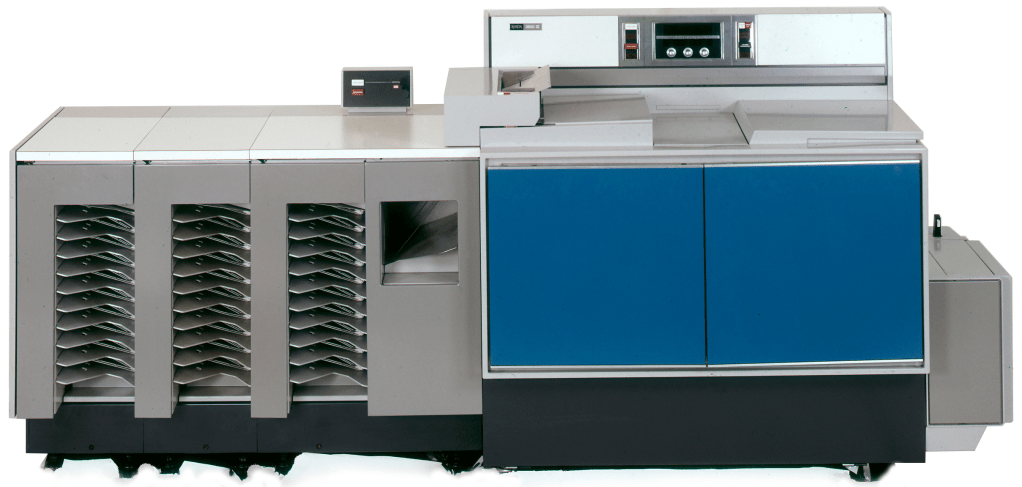
Now we are cooking!!! Xerox at this point is blasting off!!! In 1959 Xerox introduced the first plain paper photocopier, the 914, which has been the “single most successful product of all time.” The 914 was developed by Carlson and John H. Dessauer and was so popular that by the end of 1961 Xerox had almost $60 million in revenue. A smart ad campaign would show that even monkeys could make copies and simplicity would become the foundation of Xerox products. By 1965 revenues have skyrocketed over $500 million!
Obviously so, in the 1960’s Xerox dominated the photocopier market. Xerox common stock (XRX) was listed on the New York Stock Exchange in 1961 and Chicago’s in 1990 since we’re talking money. Looking ahead, in 1966 Xerox’s first foray into duplicating, was with the Xerox 2400. It was not quiet as fast as offset printing but, this machine introduced the industry’s first automatic document feeder, paper slitter and perforator and collator(sorter). I little more tinkering and the sped up the printing process a whole 50% just to introduce the Xerox 3600 Duplicator.
The 1960’s had a lot of innovation from Xerox. A small team borrowed some 914 copiers and modified them. They were working on (LDX) Long Distance Xerography, connecting two copiers using a public telephone network, so that a document could be scanned on one machine and printed on another. LDX was introduced in 1964 but, many years later it came to fruition in Xerox telecopiers. The fax operation in today’s multifunction copiers is true to Carlson’s original vison for these devices.
The 1970s introduced the Xerox 6500, its firs color copier. Then through the mid to late 70s came the “Xerox 9200 Duplicating System.” The 9200 was two times as fast as the 3600. Clocking in at two impressions per second (7200 per hour). It was then followed by the auto-duplexing 9400 and then the 9500 which added variable zoom reduction and electronic lightness/darkness control.
The company was revived through the 80s and 90s with an improvement of quality and a realignment of its product line. In 1981 Xerox introduced a line of electronic memory typewriters, the Memorywriter. The 90s brought a new era and the development of digital photocopiers gave Xerox a technical lead over its competitors. Xerox released a line of electronic production-publishing systems, DocuTech. It allowed paper documents to be scanned, electronically edited, and then printed on demand. DocuTech were the last systems to use the XNS protocol for networking.
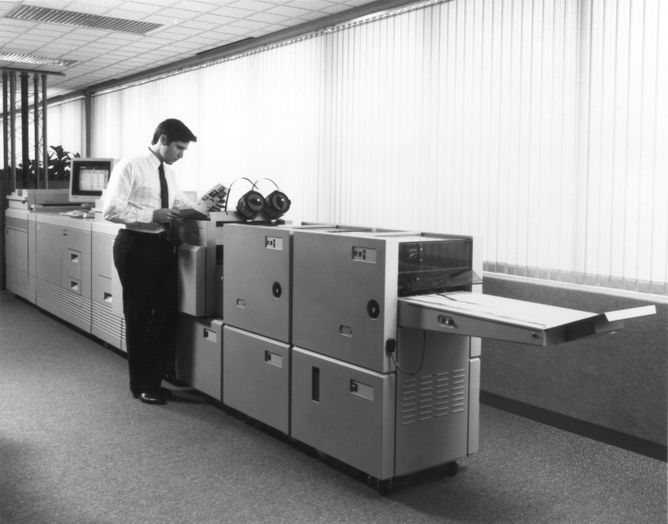
These amazing pieces of equipment had come a long way since Chester Carlson but, it was exactly as he envisioned it. Digital photocopiers were essentially high-end laser printers with integrated scanners then adding much needed features such as network printing and faxing to many models. Multi Function Machines(MFMs) were now what they were known as and could be attached to almost any computer.
Xerox became more than a product, it was now a service. It now provided a complete document service to companies including supply, maintenance, configuration, and user support. As far as Xerox business dealings and acquisitions, there was a lot of it! Over the years Xerox had a lot of ups and downs. In the early 2000s the first outsider to run Xerox, Anne M. Mulcahy, launched an aggressive turnaround plan that returned Xerox to full-year profitability by the end of 2002, along with decreasing debt, increasing cash, and continuing to invest in research and development.
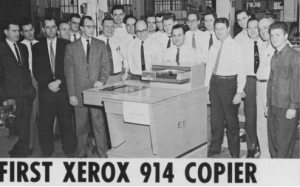
September 2004, Xerox celebrated the 45th anniversary of the Xerox 914. More than 200,000 units were made around 1959 – 1976, the year production of the 914 stopped. Today you can find Xerox 914 sitting as a piece of American history in the Smitsonian Institution. One thing I noticed while researching, the 914 tend to catch fire because of overheating. To combat this Xerox provided a “scorch eliminator”, which was actually just a small fire extinguisher. Absolutely AMAZING!!! They should honestly do the same with some of todays pre-built PC’s but, that’s another story.
Like I said, Xerox has it’s share of rich history but, before I wrap it up. It be wrong of me not to mention Xerox PARC. A facility and sect of Xerox founded in 1969 that’s responsibility was tasked with creating computer technology-related products and hardware systems. It’s because of Xerox Parc that such amazing innovations have spawned such as laser-printing, Ethernet, the modern personal computer, graphical user interface (GUI) and desktop paradigm, object-oriented programming, ubiquitous computing, electronic paper, amorphous silicon (a-Si) applications, the computer mouse, and very large scale integration (VLSI) for semiconductors.
Now you can understand the weight and impact Xerox had on the industry. I think it’s hard not to laugh at all the drama that took place between Microsoft and Apple when they were just starting out. I think a lot can be gathered by a meeting that had been held between Steve Jobs and Bill Gates to discuss a violation of their agreement. The meeting got pretty heated!
Steve bursted out saying – “You’re ripping us off!!!”, Steve shouted, raised his voice higher. “I trusted you, and now you’re stealing from us!”
But Bill Gates just stood there coolly, looking Steve directly in the eye, before starting to speak in his squeaky voice – “Well, Steve, I think there’s more than one way of looking at it. I think it’s more like we both had this rich neighbor named Xerox and I broke into his house to steal the TV set and found out that you had already stolen it.”
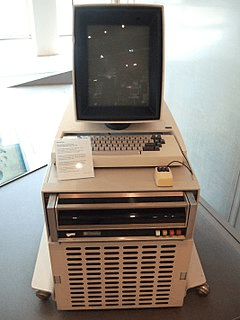
You see what I mean?! I find it incredibly interesting and Steve Jobs is even recorded saying Xerox could have been number one and that they Adopted their O/S from the Xerox Alto computer. Which was a prototype personal computer made by Xerox. It cost roughly $40,000 to build and only 2,000 units were ever built. After Steve’s buddies harped him about making it over to Xerox PARC. He finally checked it out and was shell shocked by what he witnessed there, primarily the Graphical User Interface to be clear. Nothing of the sort had been conceived let alone produced yet. After stewing in his mind and a second visit, Steve demanded the Specs and everything be handed over to him and his team. Xerox obliged and the rest is history.
There is a lot of history wrapped up into Xerox and like I said, I am so luck to be a part of it. I hope you learned something new reading this. It’s been an eye opener for me personally. I am looking forward to learning the ins and outs like I do anything. I’ll be a master in no time and cant wait to share my journey with you. Just call me Chester Carlson!! Just kidding! Appreciate it as always! Keep on coming back if you know what’s good for ya! And if you happen to have a Xerox and are in Maui, County! I’ll be seeing you most likely! Very excited, you cant even imagine!! Much love and aloha
 Riley Makena Rudd
Great Read and yes a Heavyweight in the industry – Congratulations and it’s exciting – Go Big 💪💪💪
LikeLike